Business architecture hands-on: how it all fits together
What business architecture organises, how the views and the domains connect, and why this blog brings a main area together with six practical areas.
Part 1 of 1 of the series Business architecture, hands-on.
Décio Dalke Jr. — Arquiteto de negócios. Sócio-gerente no ecossistema MitUP (mitup.pt).
Where I’m coming from
I have always been very much a person of practice, even when it came before the theory. There isn’t always time to master the craft before applying it. And there is another risk, already identified as the “Dunning-Kruger” effect: people don’t know what they don’t know. And they think what they do know is a lot!
As the saying goes, pain teaches. And that is how we learn the first steps in something new.
Obviously, theory is what lifts practice up to the level of craft.
My early experience with business architecture was basically that: first solving problems, and only afterwards discovering that concepts and techniques had already been worked out for them. It’s the bittersweet feeling of “discovering what had already been discovered”. A little frustrating, because others got there first, yet reassuring at the same time, because it validates your own journey. That happened to me on a project in the 2000s, one of my first industrial projects. I worked for a small company that was a subcontractor to a large company, which in turn was the lead on a refinery expansion project. For our company, all of it was new, challenging and daunting. The company was used to delivering one kind of service to one kind of client. Smaller, less demanding. We had to work on two fronts: what we are and what we know, and what is expected of us. Was there a match? It’s ours! Wasn’t there? Hire someone who knows.
This kind of situation is what motivates me to write. My aim with this content is to bring a hands-on view of business architecture and all its areas and domains. There is a huge amount of theory out there. Anyone can read TOGAF or the best writers on the subject. But how do we get it off the page in real situations?
What the discipline organises
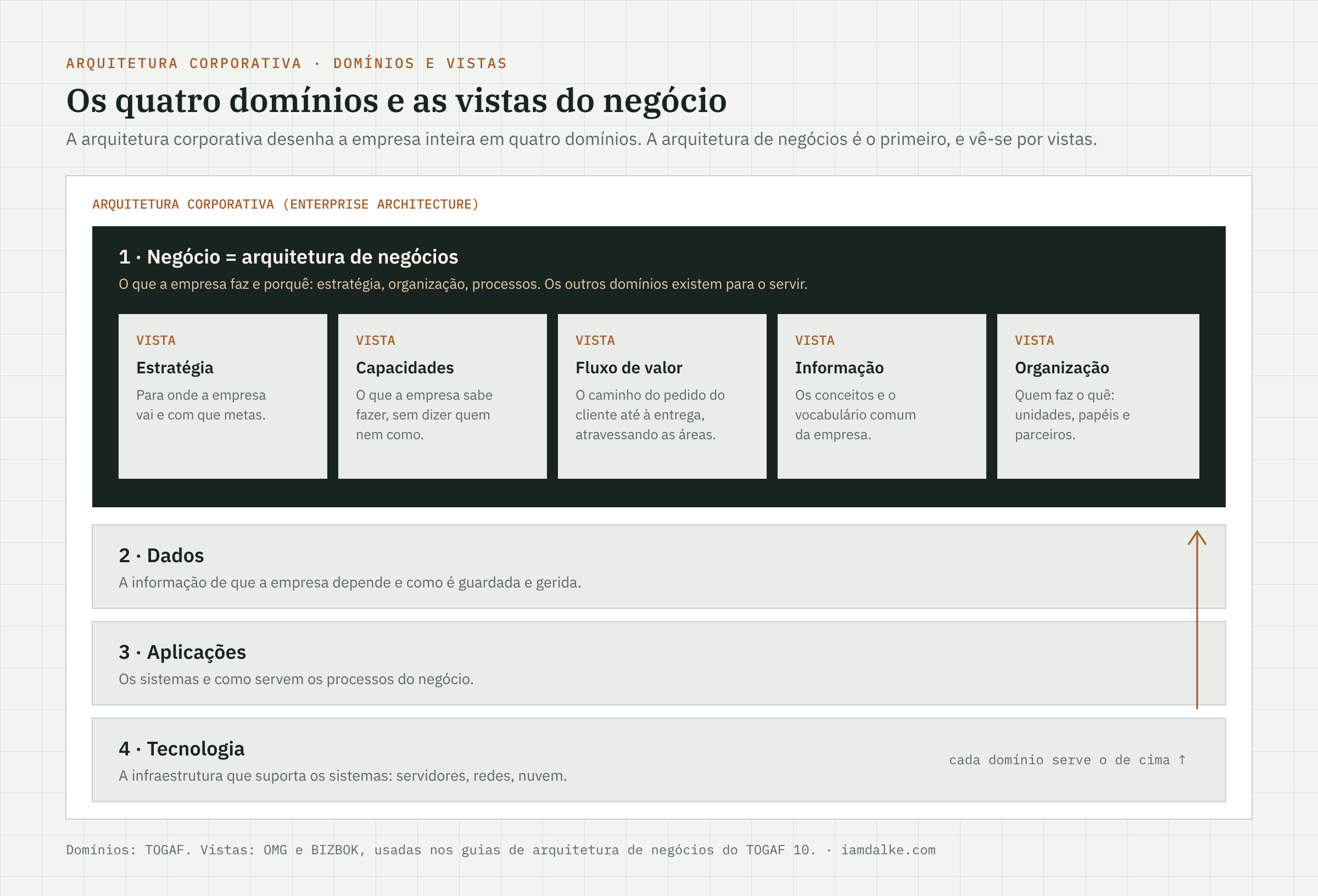
Enterprise architecture explains the pieces that make up a corporation. The domains. Business architecture shows what the company actually does. It’s the “psychoanalyst” part of the framework: who am I? Where do I come from? Where am I going? How will I get there? And, just as with a 3D shape, we can look at this entity, the Corporation, in this domain called Business, from several angles: strategy, capabilities, value stream, information and organisation. These are the views. All present at once and inseparable.
And here we have a situation where there are different professional profiles within the (immense) variety of business architect profiles. Excellent strategists who are weak at organising. Or people strong on organisational matters but with little sight of the other domains of enterprise architecture (the level above business architecture).
I, for one, believe that those of us in architecture need to provide a strong foundation for structuring the company. And to make the most of the people who really know the business when it comes to drawing out and consolidating strategies, identifying capabilities correctly and getting the value streams to the customer exactly right. A business owner is usually good at what they do; an architect needs to give the company the conditions to operate at its best.
One main area and six areas
Following this logic, we need a complete, multidisciplinary profile with a good view of the whole. As I discovered that many of my experiences were part of a single, larger machine, I came to understand the value of business architecture’s generalist view. In this blog I chose to focus on areas that are careers in their own right. But, just like in those Japanese series with colourful heroes, it’s when they come together that a new being is truly born. Bigger, stronger, more complete.
On the map, the main area sits in the business domain. The six areas reach down through the other three: data, applications and technology. Only infrastructure, whether IT or physical, is left out, because it already has its own specialists.
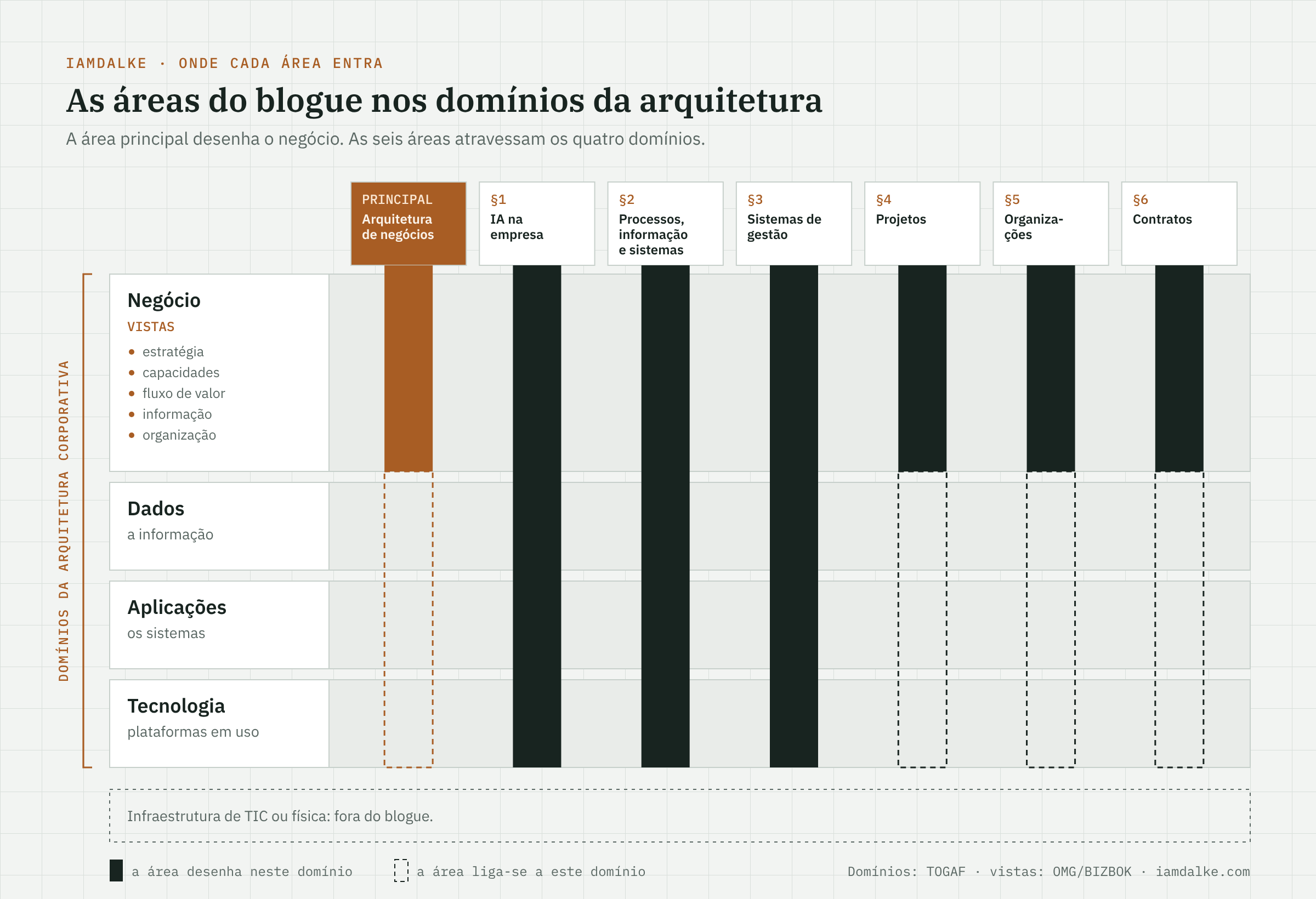
You can browse this blog for content specific to the discipline of Business Architecture. That’s the main area. But you’ll find plenty of content from areas that make up or complement business architecture. Above all, the great game changer of modern history: Artificial Intelligence. Today it’s impossible to choose to separate the use of AI from any field of work. Because of that importance, area 2 of my blog is Processes, information and systems. That’s the home that builds the foundation for good use of AI! Want AI to work? Have clear processes, defined data, structured systems. Good input, good output. Bad input? Well…
What lies beyond TOGAF: the hands-on part
This view is very personal and the fruit of many years on the road. I spent a good while working in these complementary areas. Often my main professional goal was to focus on one specific area: project management, contract administration or systems analysis (nowadays called something else). But being able to go down into the detail of these areas while keeping a view of the whole gave me a new perspective as an architect.
Knowing contract administration processes helps when contracting and managing the implementation of a tool. Telling routine tasks apart from project tasks helps enormously in managing everything outside day-to-day operations. Discussing schedule, physical and financial progress and WBS with a supplier prevents giant headaches (project management).
Practice in compliance and third-party reviews and audits teaches you to take an outside view: right, what will someone want to see here? (management systems and compliance)
The pains and shortcuts of running a business help you understand how the business owner, the manager or even the ordinary user thinks. It makes us understand: what do they actually need? It’s usually different from what they want or ask for. (managing organisations)
And when we get to the staple topic of any business gathering, “how are you using AI in your business?”, we can understand how it works and what it takes for it to bring results rather than be a “luxury WhatsApp that generates images and documents”. AI isn’t someone to chat with. AI is for cutting time and gaining scale. But with limits, governance and clear processes. (AI in the company)
The series that comes next
Over the coming weeks, eight articles go down into each piece of this map. Each line gets its link when the article comes out.
- When a company needs business architecture: for those who feel the areas no longer fit together on their own.
- Capabilities: for those who need to know what the company can do before deciding what to buy or who to hire.
- Value stream: for those who see the customer’s order get lost in the hand-offs between areas.
- Information and a common vocabulary: for those who see each area calling the same thing by a different name.
- Operating model: for those who want each role to know what it does and with what means.
- From strategy to initiatives: for those with a plan that hasn’t yet turned into projects with an owner.
- Business architecture, enterprise architecture and TOGAF: for those who want to know where each one begins and where TOGAF leaves operations behind.
- AI applied to business architecture: for those who want to put agents to work without losing control of the process.
If you come in through projects (§4), you can start with 3 and 6, which are the closest to the schedule and the portfolio.
And if you want to understand how the blog is meant to be read, the other main article is Super Mario logic.