English edition
The full catalogue is in the Portuguese edition.
World 1 of Contracts
- World 1 of Contracts, level 1: where it all begins
Contract administration means managing the contract throughout the project, and the first job is reading and mapping what it says. The claim is just the visible tip.
The treadmill never stops
- More work in less time doesn't give you free time
AI does in minutes what used to take hours, and even so the diary stays full. The time saved gets filled with more work, unless someone decides otherwise.
- FOMO: the latest resource, the latest agent, the latest solution
While studying for ISO 42001, I fell into a bubble of AI news that fed my FOMO. Testing what came in brought the calm back, while the fear of becoming obsolete is still real.
Business architecture, hands-on
- Business architecture hands-on: how it all fits together
What business architecture organises, how the views and the domains connect, and why this blog brings a main area together with six practical areas.
A different 7–1 every day
- A different 7–1 every day - The series!
8 July 2014, Brazil 1–7 Germany. Working with AI often brings the same feeling: how did nobody see it coming? A series for learning from someone else's mistakes.
- Almost a million tokens for nothing
A whole night of work with AI agents and almost a million tokens. What they did stayed, while the why was lost. Knowledge can be rebuilt, but at what cost?
- Five skills cut off mid-word
Five sets of instructions for AI agents turned up cut off in the middle of a word, with no error and no warning, and the agent kept following what it had.
- Two agents, one file and an approved decision that disappeared
A rule I had approved vanished from a log where nothing is ever deleted, because two chats saved the same file and the last one to save won.
- Three rounds of guessing, with the code right there
An agent spent three rounds testing hypotheses on a live server, while the code and documentation that held the answer were public and close at hand.
- A topic forgotten in the wrong chat
A complex topic was split across several chats to protect focus, and one reply in the wrong chat was enough for the agent to lose track of what it had to do.
World 1 of Organisations
- World 1 of Organisations, level 1: where it all begins
Managing a company starts with a client's problem, internal or external, and with the tripod of people, processes and tools. The organisation chart comes later.
- World 1 of Organisations, level 2: underground
Before changing an organisation, you need to know where it stands. The diagnosis, the maturity levels and the report that gets decision-makers to act.
- World 1 of Organisations, level 3: up in the sky
When everything demands attention at once, a triage pyramid decides what to tackle first, before Pareto and ABC analysis. And why the loudest problem is not always the most serious.
The Super Mario Logic
- The Super Mario Logic
The logic of Super Mario's levels applied to business architecture: from simple to complex, level by level.
World 1 of Projects
- World 1 of Projects, level 1: where it all begins
A project has a goal, an end and a limited set of resources. What that changes in how you manage it — and why almost everything that changes something in a company is a project.
- World 1 of Projects, level 2: underground
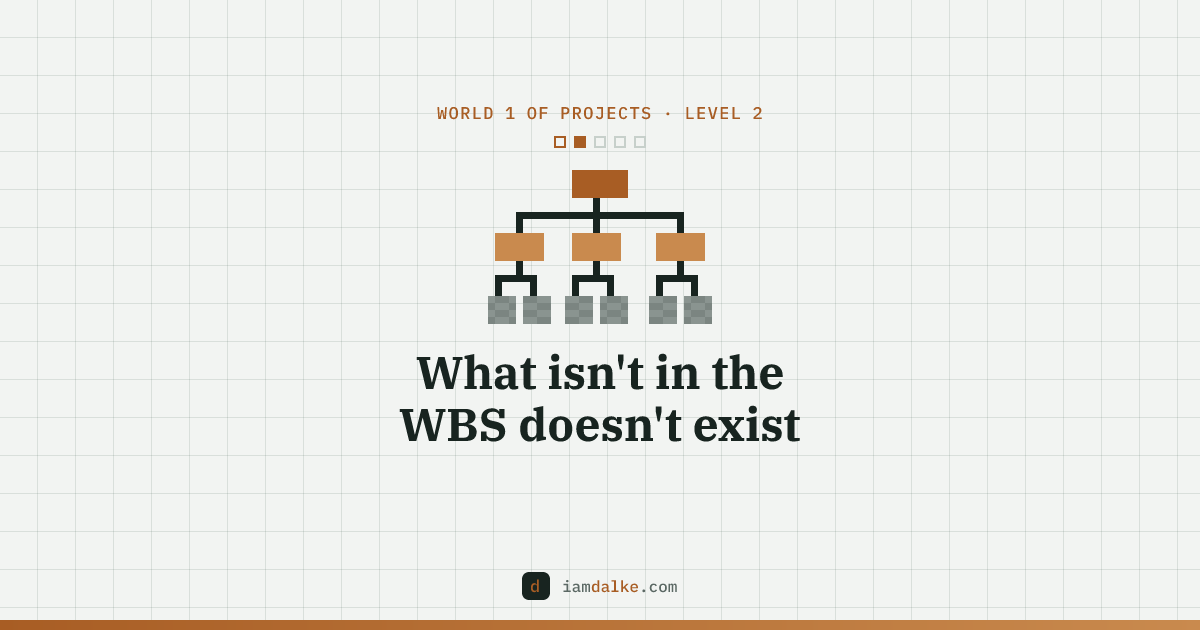
Scope is the list of what the client asked for and also of what's left out. How to break the work down into a WBS, how far down to go, and why the rest of the project hangs on it.
- World 1 of Projects, level 3: up high
From scope to schedule, resources and cost: how the plan links together. What the baseline is, why no improvement can be proven without the “before”, and who decides when it changes.
- World 1 of Projects, level 4: what holds the platforms up
Money spent isn't work done. How to measure a project's real progress, read the S-curve, deal with variance and write the right report for whoever decides.
- World 1 of Projects, level 5: the castle
PMBOK is a guide; whoever manages chooses the method. Agile plans too. Scrum is one specific way to play. When each approach fits, and what's left of the four previous levels in any of them.
World 1 of AI
- World 1 of AI, level 1: where it all begins
AI is an assistant — junior or senior, depending on who runs it. The four possible uses, the method each one needs, and the question that comes before any tool: how will you check the result?
- World 1 of AI, level 2: underground
Why AI needs data, context and structure; what tokens are and why more context isn't better context; where hallucination comes from — and the method rules that came out of running this every day.
- World 1 of AI, level 3: up high
At each level — chat, chat with context, AI inside Office, an agent on your computer, automation with no interface — the AI does more without you watching. The right question is who checks, what can break and what a mistake costs.
- World 1 of AI, level 4: what holds the platforms up
What makes AI work in a company is what you build around the model: what it sees, where it looks things up, how it acts, how you know it got it right and what stops it from getting it wrong. And when RAG or fine-tuning is worth it.
- World 1 of AI, level 5: the castle
Big model or small, open or closed, train, fine-tune or distil, run it in the cloud or on your own computer. What each choice changes, what it costs, and why the model is the piece that decides the least.
- The holy trinity of project management: scope, time, resources
Scope, time and resources make up a project's triple constraint. Why anyone who fixes all three at once has already chosen, without knowing it, where the project will give way.
- Automating a task is not automating a process
The company buys the software, the task gets faster and the gain never shows up. The difference between automating a task and automating a process, with a case from an industrial project.
- Contract administration isn't (just) claims
A 2013 article, first published in Brazil's Guia da Construção: contract administration should follow the contract from the start of the project, and the claim is only one of its fruits.