Contract administration isn't (just) claims
A 2013 article, first published in Brazil's Guia da Construção: contract administration should follow the contract from the start of the project, and the claim is only one of its fruits.
New to this topic? Start with World 1 of Contracts.
Décio Dalke Jr. — Arquiteto de negócios. Sócio-gerente no ecossistema MitUP (mitup.pt).
First published in Portuguese in the Brazilian magazine Guia da Construção (Editora Pini) in May 2013, and later on LinkedIn.
This subject is even more current and in tune with the market’s new reality.
Setting up a team dedicated specifically to preparing claims is common practice among construction companies, especially those that serve the public sector. The contractor’s need to prepare these claims usually arises from realising it has been harmed, because the working schedule has drifted far from the original plan (or from the latest re-plan). Or else the budgeted cost blows up before the end of the project, forcing the contractor to divert the contingency fund (when there is one) to cover the project’s operating cost - or worse, to cut the estimated profit margin, even down to “break-even” between revenue and expenses.
It is unacceptable to discover only when the claim is being prepared that there is an information gap in unmonitored processes and unmeasured results
Better-structured companies start the project with a Contract Administration (CA) team, following the contract to look for “gaps” and opportunities to increase revenue. In both situations, contract administration is usually seen as a department set apart from the contract’s routine process, called upon for specific events and with direct purposes: financial gain or recovery or, as a last resort, defence against contractual penalties.
What happens when contract administration is called in? Other departments are overloaded, especially planning, with preparing studies and documents, gathering (poorly) recorded information and communicating with the client - plus whatever other documents are deemed relevant to the specific claim. In other words, what each department produces in its routine is not enough to prove the contract was correctly executed, or to secure rights when the client threatens or withholds them in the contractual relationship. As Professor Alvaro Camargo puts it in an article on his blog, disputes between client and contractor will only be settled satisfactorily if the facts and evidence have been (very) well documented. (Camargo, Alvaro: A burrice nos processos de Administração Contratual. http://alvarocamargo.wordpress.com/2009/12/03/burrice-contratual/. Accessed 13 February 2013).
Unfortunately, in most cases, what the departments responsible for executing the project produce is not even enough to monitor the contract’s execution properly, which turns CA into an activity set off by an emergency trigger.
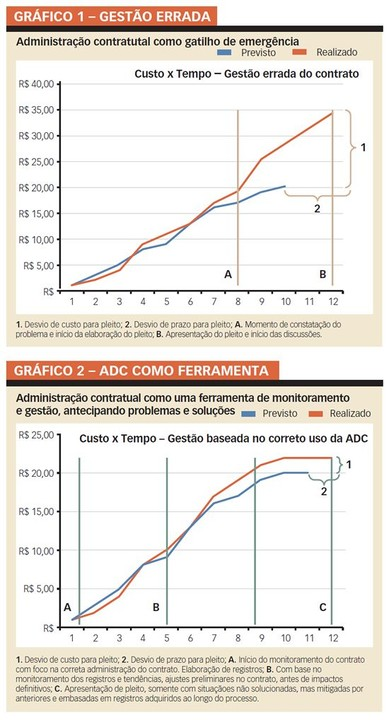
A new proposal for CA
The new (or correct) proposal for Contract Administration is for it to be part of the contract’s management and monitoring processes, born in Integration Management and acting as a new, complementary focus within the Planning and Control processes. Change management, which would be Contract Administration’s main tool, must be fully integrated with sound Scope Management and Time Management.
But much more than that, the primary function of Contract Administration must be to ensure the Contract is executed correctly, that is, to be an essential tool for the project manager in ensuring that every clause and standard relevant to the project is carried out. And by ensuring, read constant monitoring of how contractual obligations are being fulfilled. Because only those who owe nothing can demand. And only those who have already done their part (or found someone to do it) owe nothing.
CA begins with a complete mapping of scope definitions, contractual rights and obligations. It goes on to spread this information widely across the whole contract team, and rests on monitoring how it is carried out. By creating checks and hold points, it is possible to spot conflicting situations and follow how they unfold, using the tools and information of the project’s own execution; and if a claim really does need to be prepared, it should be the end of the control process and not the start of new processes. It is unacceptable to discover only when the claim is being prepared that there is an information gap in unmonitored processes and unmeasured results.
Contract Administration should already guide the preparation of the Work Breakdown Structure (WBS), since it must foresee additional control needs at critical points of the contract (equipment supplied by the client, for example). That way, any deviations can easily be controlled by routine management processes, reducing the likelihood of information gaps at times of conflict. Not defining which data must be collected, or failures in the procurement processes, are damaging and can destroy the chances of a claim succeeding, even the chance of preparing one at all.
The claim as a CA instrument
This article does not set out to discuss contract-monitoring techniques or tools, or strategies for preparing claims. Its aim is to shed light on the view that a claim is a consequence of a contract that has been very well executed, managed and monitored. The claim is one of the fruits of Contract Administration, not its main objective.
A claim, although often fair and rightful, depends on the client’s acceptance. And that acceptance usually conflicts with the stakeholders’ interests (time and cost).
Take the new stance of one of Brazil’s largest clients, Petrobras: this tool, as a way of rebalancing the contract, will be used far more restrictively. Approval of a claim to recover the margin needed after signing a contract won at prices below the necessary minimum is no longer a “sure thing”. (Filgueiras, M. Luiza: Acabou a mamata na Petrobras. Exame On line. 26 November 2012. http://exame.abril.com.br/revista-exame/edicoes/1029/noticias/acabou-a-mamata. Accessed 13 February 2013).
This means that claims for time and cost will, more than ever, have to be very well substantiated, the product of a control process far broader and more effective than the one most companies in the construction and assembly market practise today.
Since a claim is a matter of discussion between client and contractor, the starting point is integrity and fair dealing in the commercial relationship. Even so, the correct interpretation and acceptance of a claim depend on contract clauses with clear definitions regarding time and cost deviations. Unfortunately, that contractual clarity is missing from most contracts. Criteria and guidance can also be adopted, such as those set out by the Society of Construction Law (SCL) in its Delay and Disruption Protocol (Society of Construction Law. Delay and Disruption Protocol. Available at http://www.eotprotocol.com/. Accessed 13 February 2013). This document is an excellent guide to running the contract, from gathering records to the criteria for defining a claim and analysing it. Even so, the claim’s success will depend on the client’s acceptance. And, in the worst cases, on the intervention of third parties such as arbitrators or even the courts.
By running management that is not only effective but efficient, many claims can be avoided, with their root causes identified while they can still be treated as future events, before they hit the time x quality x cost tripod, and handled without much friction through change management.