World 1 of Projects, level 2: underground
Scope is the list of what the client asked for and also of what's left out. How to break the work down into a WBS, how far down to go, and why the rest of the project hangs on it.
Part 2 of 5 of the series World 1 of Projects.
Décio Dalke Jr. — Arquiteto de negócios. Sócio-gerente no ecossistema MitUP (mitup.pt).
World 1 of Projects series — level 2 of 5: World 1-1 · World 1-2 · World 1-3 · World 1-4 · World 1-5
Super Mario’s underground hides a secret that plenty of people stumbled on by accident. At the end of the underground level, anyone who climbs up and runs along the top of the ceiling finds the Warp Zone: pipes that take you straight to worlds further ahead. You get there faster, though without having learnt anything you skipped along the way.
Every project has its own Warp Zone: skipping the scope and going straight to the schedule. Despite looking like a time saver, it’s where most problems are born, long before they show up in any date.
What is scope, and what’s left out of it?
The most common idea is that scope is the list of what the client asked for. In fact, it’s the list of what will be delivered and the list of what won’t.
The second half is the one nobody writes down. And it’s exactly the one that turns into an argument halfway through: “but I thought that was included”. If it wasn’t written down as out, then for whoever asked, it was in.
A well-closed scope answers three questions without hesitating:
- What exactly will exist at the end?
- How will we know it’s done (the acceptance criterion)?
- What, on purpose, isn’t part of it?
What is a WBS?
The WBS (work breakdown structure) is the hierarchical decomposition of the total scope of work the team will carry out to achieve the project’s objectives and create its deliverables [1].
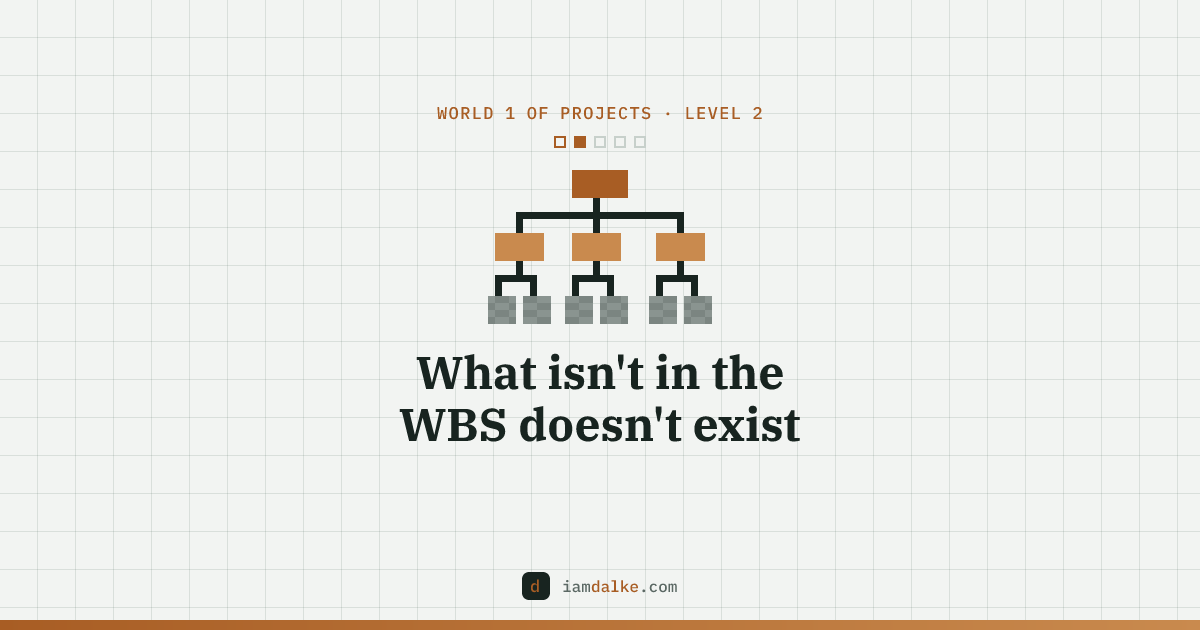
In practice, it’s a tree. At the top, the whole project. Just below, the big deliverables. Below each of them, the parts that make it up. And so on, until you reach pieces someone can estimate, assign and be held to.
One rule keeps the tree standing: the 100% rule. Each level has to contain everything the level above contains, no more and no less [1]. If a piece of work isn’t on any branch, it isn’t in the project. And if it’s on two, it’ll be done (and paid for) twice.
How far down do you break it?
Until the work fits in your hand. A practical test: while you’re describing what will be delivered (nouns: “report”, “electrical panel”, “billing module”), you’re still in the WBS. When what will be done starts to appear (verbs: “assemble”, “test”, “review”), you’ve hit the bottom and the activities begin [1].
Going too deep is also a mistake. A WBS with thousands of lines that nobody updates is worse than one with fifty that everybody uses.
On a construction site, the bottom of the tree is very concrete. When I was responsible for the piping discipline in a construction consortium, the tree started from the isometric (the drawing that defines a section of piping), went down to each spool (the part of that section prefabricated in the workshop), and control went all the way down to the joint, every weld. For each spool and each isometric, we cross-checked the bill of materials against stock, in order of priority, before the piece went to fabrication. That was the level where the work fitted in your hand: joint by joint, you could tell what was done and what was left.
Why does everything else hang on it?
Because time, cost and resources are estimated for each piece of the WBS, and then added up.
Without a WBS, the schedule is a wish list with dates, and the budget is a number someone thought was reasonable.
With a WBS, every piece has an owner, an estimated effort and a cost. The total stops being a guess and becomes a calculation. And when the client asks for “just one more little thing”, you can show which branch it goes on and how much it weighs. That’s exactly where a contract variation is born, or avoided.
What isn’t in the WBS doesn’t exist in the project until the day it shows up on the bill.
Quick questions
What is project scope? What will be delivered and how you’ll know it’s done. And, just as important, what’s left out, which is the part almost nobody writes down.
What is a WBS? The project’s tree: the whole scope broken down into smaller and smaller deliverables, to the point where someone can estimate and take on each piece.
What is the 100% rule? Each level of the WBS contains exactly the work of the level above. Nothing missing, nothing repeated.
How far down should a WBS go? Until it fits in your hand. When the description stops being about deliverables (nouns) and turns into actions (verbs), you’ve reached the activities.
References
- Burek, P. (2013). The ABC basics of the WBS. PMI Learning Library. https://www.pmi.org/learning/library/work-breakdown-structure-basics-5919 — accessed 2026-09-25.